
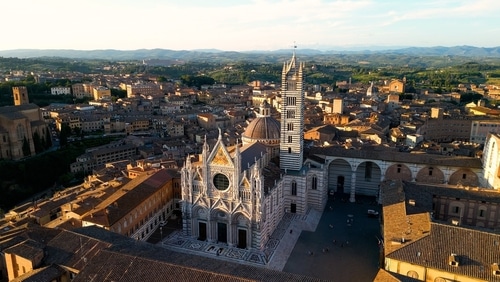
Visiting Siena for the first time means one thing: you absolutely must experience the Siena Cathedral, known locally as the Duomo di Siena. This striking black-and-white striped masterpiece sits at the top of the city and is one of Italy’s most unforgettable churches. If the Florence Duomo is grand and monumental, the Siena Cathedral is intimate, dramatic, and richly decorated — perfect for travelers who want a powerful first impression without complicated planning. This guide keeps everything simple, practical, and ideal for beginners.
A Short History of the Siena Cathedral
The Siena Cathedral began taking shape in the 12th century, during a time when Siena was one of Italy’s wealthiest and most ambitious cities. Its people intended to create a cathedral that would not only rival Florence but surpass every church in Tuscany. Their symbol of power became the iconic black-and-white striped marble exterior — colors tied to Siena’s legendary founders, Senius and Aschius, the sons of Remus.
In the 1300s, Siena started an even bigger expansion project to transform the cathedral into the largest in Europe. But disaster struck: the Black Death swept through the city in 1348, killing much of the population and bringing the project to an abrupt end. The half-built “New Cathedral” still stands today as a dramatic reminder of the city’s lost dream. These haunting walls form part of the modern viewpoint above the city, known as the Facciatone, which visitors can still climb.
The cathedral you see today, though never expanded to its original plan, remains one of the richest expressions of medieval art in Europe.
Exploring the Siena Cathedral Complex
The Siena Cathedral is not just one building — it’s a collection of remarkable spaces connected through a single ticket known as the OPA Si Pass. This flexible pass allows entry to the cathedral, the Piccolomini Library, the Baptistery, the Crypt, the Opera Museum, and the panoramic Facciatone viewpoint.
Each part of the complex offers a different type of beauty. The Baptistery below the cathedral glows with Renaissance frescoes. The 14th-century Crypt — discovered only in the early 2000s — is filled with vivid, unexpectedly well-preserved medieval paintings. The Opera Museum showcases original statues by Pisano and Donatello that once stood outside the cathedral. And if you climb the Facciatone, you’ll step onto a narrow walkway above Siena with sweeping views of terracotta rooftops and Tuscan hills.
The cathedral itself remains the heart of the experience. Its atmosphere feels dramatic from the moment you walk inside.
What’s Inside the Siena Cathedral
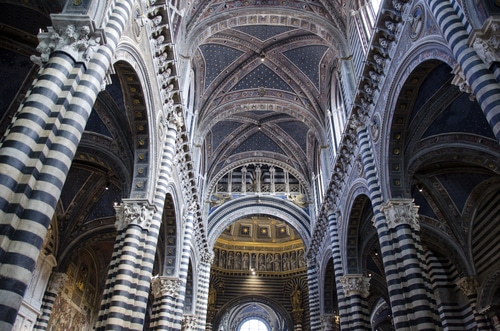
The interior of the Siena Cathedral is one of the most visually stunning spaces in Italy. Everywhere you look, there is detail — striped marble pillars, golden ceilings, painted vaults, and sculptures by masters like Bernini, Pisano, and Donatello. The entire floor is a monumental work of art, made up of marble panels depicting biblical scenes and allegories. Most of the year the floor is partially covered for protection, but during specific weeks (usually late summer to early autumn), the entire masterpiece is revealed.
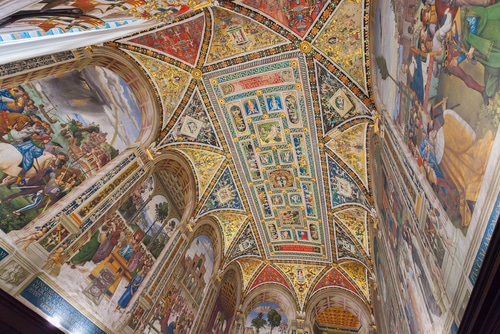
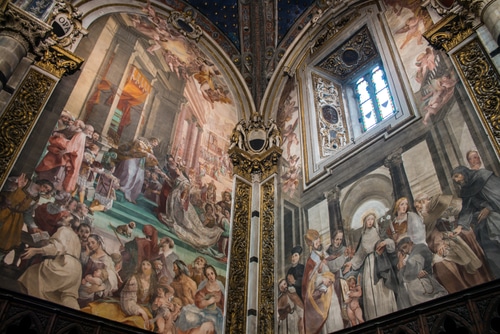
One of the highlights inside is the Piccolomini Library, a bright and colorful room decorated with enormous frescoes by Pinturicchio. The scenes celebrate the life of Pope Pius II, a Sienese hero, and glow with Renaissance colors and gold details that look almost new. This library alone makes the visit worthwhile, especially for first-time travelers who enjoy vibrant, story-filled artwork.
The cathedral’s pulpit, designed by Nicola Pisano, is another standout. With its intricate marble panels carved with biblical scenes, it represents a turning point in Italian sculpture — a bridge between medieval art and the coming Renaissance.
Hidden Details Most Visitors Miss
The Siena Cathedral hides many small treasures that are easy to overlook. One of the most surprising is the star-filled ceiling above the nave, deep blue with golden constellations meant to represent the night sky. Another is the elegant marble inlay of the She-Wolf of Siena, a symbol tied to the city’s legendary founders.
Many travelers also miss the cathedral’s impressive organ, one of the largest in Italy. When music fills the building, the echo creates a powerful and immersive atmosphere. And for those who take their time, the cathedral’s side chapels reveal unexpected works by artists you may recognize from Florence, Rome, or Venice.
How Ticketing Works (and What You Should Know)
For most travelers, the OPA Si Pass is the easiest and most efficient way to explore everything without confusion. The pass usually includes:
- Cathedral
- Baptistery
- Crypt
- Piccolomini Library
- Opera Museum
- Facciatone viewpoint
It is valid for multiple days, which is helpful if you prefer to explore at a slower pace. The only timed entry is typically the viewpoint climb, which has limited capacity because the walkway is narrow. Booking your slot early in the day or early in your trip helps avoid disappointment.
The cathedral has a modest dress code: covered shoulders and knees, no hats, and respectful behavior. Bags are allowed but should be small, especially if you plan to climb the Facciatone.
Planning Your Visit Efficiently
The Siena Cathedral sits high above the city, so expect a bit of uphill walking, especially if you’re approaching from the train station. For the smoothest experience, enter the cathedral early in the morning when light streams through the windows and crowds are lighter.
If you’re short on time, prioritize three spaces:
the cathedral interior, the Piccolomini Library, and the Facciatone viewpoint.
These alone give you an extraordinary experience blending art, architecture, and unforgettable views.
On hot days, consider exploring the museum and crypt in the afternoon, as both are quiet and cool. If you visit during the period when the cathedral floor is fully uncovered, plan extra time — it becomes one of the most beautiful art displays in Italy.
In a Nutshell
The Siena Cathedral is a masterpiece that combines medieval imagination, Renaissance painting, and thousands of tiny artistic details into one unforgettable visit. With its striped marble, brilliant artwork, and soaring views from the Facciatone, it offers a completely different experience from the Florence Duomo — more intimate, more ornate, and deeply tied to Siena’s proud identity.
With a good ticket, a little preparation, and this simple guide, even first-time travelers can explore the Siena Cathedral with ease and confidence. Whether you’re drawn by its history, its art, or the extraordinary beauty of its interior, the Siena Cathedral will become one of the highlights of your time in Tuscany.